Is It Difficult to Read an Ultrasound
Learning Objectives
By the cease of this section, you will exist able to:
- Define acoustic impedance and intensity reflection coefficient.
- Describe medical and other uses of ultrasound applied science.
- Summate acoustic impedance using density values and the speed of ultrasound.
- Calculate the velocity of a moving object using Doppler-shifted ultrasound.
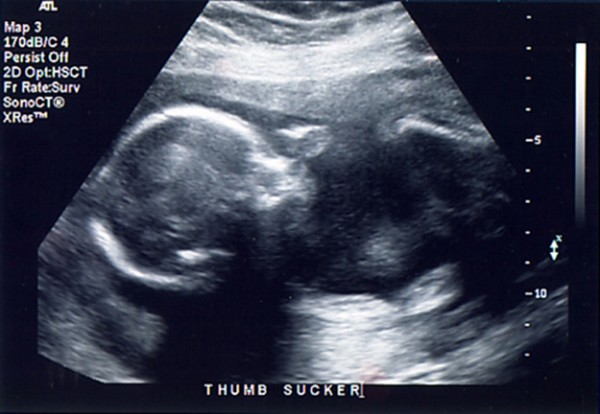
Figure 1. Ultrasound is used in medicine to painlessly and noninvasively monitor patient health and diagnose a wide range of disorders. (credit: abbybatchelder, Flickr)
Whatever sound with a frequency in a higher place 20,000 Hz (or 20 kHz)—that is, above the highest audible frequency—is defined to be ultrasound. In practice, it is possible to create ultrasound frequencies up to more than than a gigahertz. (College frequencies are difficult to create; furthermore, they propagate poorly because they are very strongly absorbed.) Ultrasound has a tremendous number of applications, which range from infiltrator alarms to use in cleaning fragile objects to the guidance systems of bats. We brainstorm our discussion of ultrasound with some of its applications in medicine, in which information technology is used extensively both for diagnosis and for therapy.
Characteristics of Ultrasound
The characteristics of ultrasound, such equally frequency and intensity, are wave backdrop common to all types of waves. Ultrasound as well has a wavelength that limits the fineness of particular it can detect. This characteristic is true of all waves. We can never observe details significantly smaller than the wavelength of our probe; for example, nosotros will never run into private atoms with visible calorie-free, because the atoms are so pocket-size compared with the wavelength of light.
Ultrasound in Medical Therapy
Ultrasound, like whatsoever moving ridge, carries energy that tin be absorbed past the medium conveying information technology, producing effects that vary with intensity. When focused to intensities of 10three to x5 Due west/m2, ultrasound can be used to shatter gallstones or pulverize cancerous tissue in surgical procedures. (Encounter Figure two.) Intensities this cracking can damage individual cells, variously causing their protoplasm to stream inside them, altering their permeability, or rupturing their walls through cavitation. Cavitation is the creation of vapor cavities in a fluid—the longitudinal vibrations in ultrasound alternatively compress and expand the medium, and at sufficient amplitudes the expansion separates molecules. Most cavitation damage is done when the cavities collapse, producing even greater shock pressures.
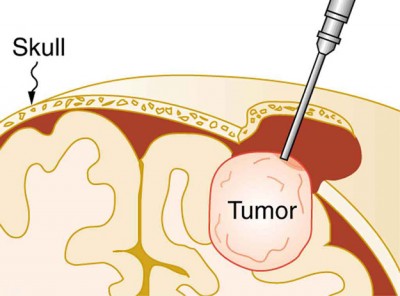
Effigy ii. The tip of this small probe oscillates at 23 kHz with such a large aamplitude that it pulverizes tissue on contact. The debris is so aspirated. The speed of the tip may exceed the speed of sound in tissue, thus creating shock waves and cavitation, rather than a polish elementary harmonic oscillator–blazon wave.
Most of the energy carried by loftier-intensity ultrasound in tissue is converted to thermal energy. In fact, intensities of 103 to x4 Due west/m2 are commonly used for deep-heat treatments called ultrasound diathermy. Frequencies of 0.viii to ane MHz are typical. In both athletics and physical therapy, ultrasound diathermy is virtually often practical to injured or overworked muscles to relieve pain and improve flexibility. Skill is needed by the therapist to avoid "bone burns" and other tissue harm acquired by overheating and cavitation, sometimes fabricated worse by reflection and focusing of the ultrasound by articulation and bone tissue.
In some instances, you lot may encounter a dissimilar decibel scale, called the audio force per unit area level, when ultrasound travels in h2o or in human and other biological tissues. We shall not utilise the scale here, but it is notable that numbers for sound force per unit area levels range 60 to 70 dB higher than you would quote for β, the audio intensity level used in this text. Should you encounter a sound pressure level of 220 decibels, then, it is not an astronomically high intensity, simply equivalent to about 155 dB—high plenty to destroy tissue, but not as unreasonably loftier as it might seem at first.
Ultrasound in Medical Diagnostics
When used for imaging, ultrasonic waves are emitted from a transducer, a crystal exhibiting the piezoelectric effect (the expansion and wrinkle of a substance when a voltage is applied beyond it, causing a vibration of the crystal). These high-frequency vibrations are transmitted into whatsoever tissue in contact with the transducer. Similarly, if a pressure is applied to the crystal (in the form of a wave reflected off tissue layers), a voltage is produced which tin can exist recorded. The crystal therefore acts as both a transmitter and a receiver of audio. Ultrasound is also partially absorbed by tissue on its path, both on its journeying abroad from the transducer and on its return journey. From the fourth dimension betwixt when the original signal is sent and when the reflections from various boundaries between media are received, (as well equally a mensurate of the intensity loss of the signal), the nature and position of each boundary betwixt tissues and organs may be deduced.
Reflections at boundaries between two different media occur because of differences in a characteristic known as the audio-visual impedance Z of each substance. Impedance is divers asZ =ρv, where ρ is the density of the medium (in kg/m3) and v is the speed of sound through the medium (in yard/south). The units for Z are therefore kg/(thousand2 · s).
Table 1 shows the density and speed of audio through various media (including various soft tissues) and the associated acoustic impedances. Note that the audio-visual impedances for soft tissue do not vary much simply that there is a big departure betwixt the acoustic impedance of soft tissue and air and likewise between soft tissue and os.
| Table ane. The Ultrasound Properties of Various Media, Including Soft Tissue Establish in the Body | |||
|---|---|---|---|
| Medium | Density (kg/miii) | Speed of Ultrasound (m/southward) | Acoustic Impedance (kg/(yardtwo · south)) |
| Air | 1.three | 330 | 429 |
| Water | m | 1500 | 1.v × 106 |
| Blood | 1060 | 1570 | 1.66 × 10⁶ |
| Fat | 925 | 1450 | one.34 × 10vi |
| Muscle (average) | 1075 | 1590 | 1.70 × 10⁶ |
| Bone (varies) | 1400–1900 | 4080 | 5.vii × ten6 to 7.8 × 10⁶ |
| Barium titanate (transducer textile) | 5600 | 5500 | thirty.8 × 10vi |
At the purlieus betwixt media of unlike acoustic impedances, some of the wave energy is reflected and some is transmitted. The greater the deviation in acoustic impedance between the two media, the greater the reflection and the smaller the transmission.
The intensity reflection coefficient a is divers as the ratio of the intensity of the reflected wave relative to the incident (transmitted) wave. This statement tin be written mathematically equally [latex]a=\frac{\left(Z_2-Z_1\right)^2}{\left(Z_1+Z_2\right)^two}\\[/latex], where Z 1 and Z 2 are the acoustic impedances of the two media making up the boundary. A reflection coefficient of nada (respective to total manual and no reflection) occurs when the acoustic impedances of the two media are the same. An impedance "friction match" (no reflection) provides an efficient coupling of audio energy from one medium to another. The paradigm formed in an ultrasound is made past tracking reflections (as shown in Figure 3) and mapping the intensity of the reflected sound waves in a two-dimensional airplane.
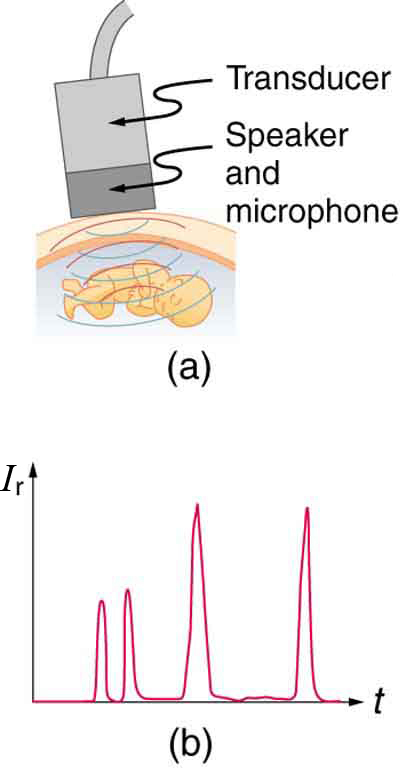
Effigy 3. (a) An ultrasound speaker doubles as a microphone. Brief bleeps are broadcast, and echoes are recorded from various depths. (b) Graph of echo intensity versus time. The time for echoes to return is directly proportional to the distance of the reflector, yielding this information noninvasively.
Example one. Calculate Acoustic Impedance and Intensity Reflection Coefficient: Ultrasound and Fat Tissue
- Using the values for density and the speed of ultrasound given in Table 1, show that the acoustic impedance of fat tissue is indeed i.34 × 10half dozen kg/(m2 · s).
- Calculate the intensity reflection coefficient of ultrasound when going from fatty to musculus tissue.
Strategy for Part 1
The acoustic impedance tin can be calculated using Z =ρv and the values for ρ and v institute in Table ane.
Solution for Function 1
Substitute known values from Tabular array 1 intoZ =ρv:Z = ρv = (925 kg/yardiii)(1450 m/s)
Summate to find the acoustic impedance of fat tissue: 1.34 × 10six kg/(mii · due south)
This value is the same as the value given for the audio-visual impedance of fatty tissue.
Strategy for Part ii
The intensity reflection coefficient for any boundary between ii media is given by [latex]a=\frac{\left(Z_2-Z_1\right)^2}{\left(Z_1+Z_2\right)^2}\\[/latex], and the acoustic impedance of muscle is given in Table 1.
Solution for Function 2
Substitute known values into [latex]a=\frac{\left(Z_2-Z_1\right)^ii}{\left(Z_1+Z_2\right)^two}\\[/latex] to observe the intensity reflection coefficient:
[latex]\displaystyle{a}=\frac{\left(Z_2-Z_1\right)^2}{\left(Z_1+Z_2\right)^2}=\frac{\left(1.34\times10^6\text{ kg/(m}^ii\cdot\text{s})-ane.lxx\times10^6\text{ kg/(m}^2\cdot\text{south})\right)^2}{\left(1.70\times10^6\text{ kg/(one thousand}^ii\cdot\text{south})+1.34\times10^6\text{ kg/(m}^ii\cdot\text{south})\right)^2}=0.014\\[/latex]
Discussion
This result means that simply 1.4% of the incident intensity is reflected, with the remaining beingness transmitted.
The applications of ultrasound in medical diagnostics have produced untold benefits with no known risks. Diagnostic intensities are too low (about x−ii W/mtwo) to crusade thermal damage. More significantly, ultrasound has been in use for several decades and detailed follow-upwards studies do not show prove of ill effects, quite unlike the case for x-rays.
The near common ultrasound applications produce an paradigm like that shown in Figure 4. The speaker-microphone broadcasts a directional axle, sweeping the beam across the expanse of interest. This is achieved by having multiple ultrasound sources in the probe's head, which are phased to interfere constructively in a given, adjustable direction. Echoes are measured as a office of position as well as depth. A estimator constructs an image that reveals the shape and density of internal structures.
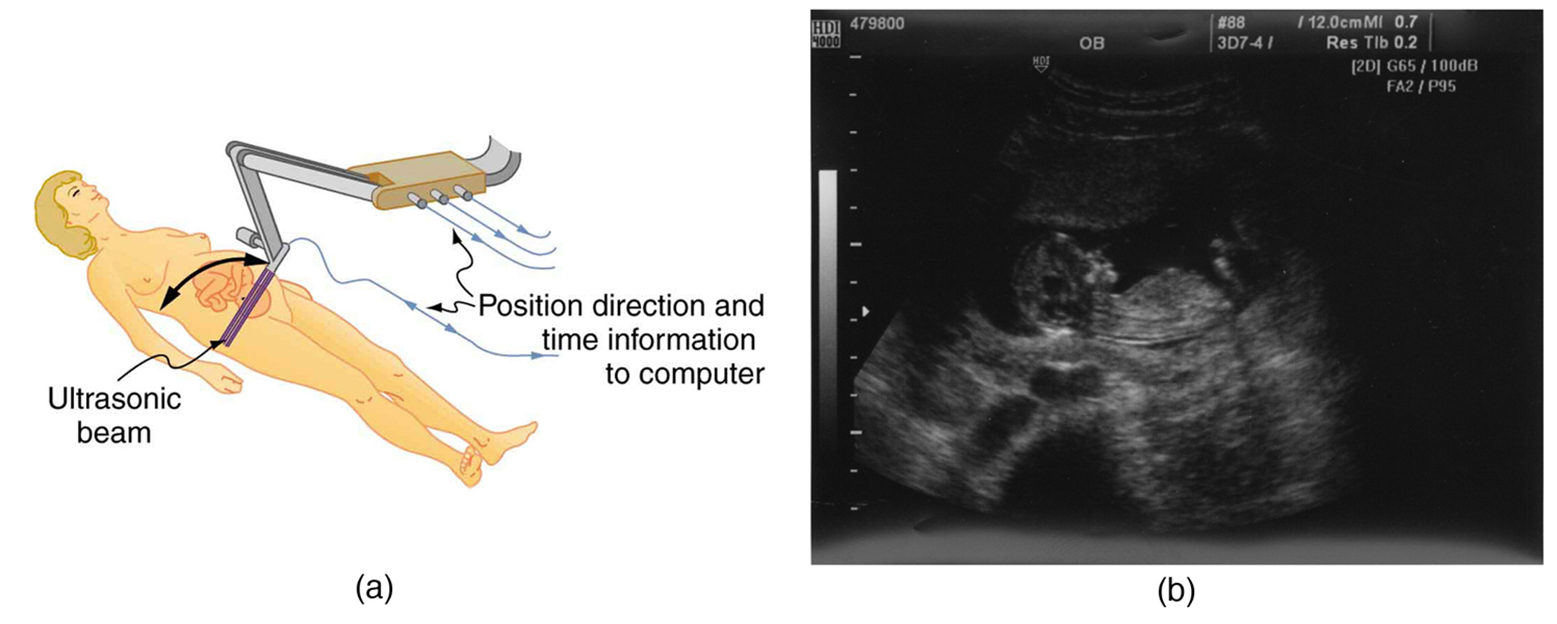
Effigy 4. (a) An ultrasonic image is produced by sweeping the ultrasonic beam across the area of interest, in this case the adult female's belly. Information are recorded and analyzed in a computer, providing a two-dimensional image. (b) Ultrasound paradigm of 12-week-old fetus. (credit: Margaret W. Carruthers, Flickr)
How much particular can ultrasound reveal? The epitome in Figure iv is typical of low-cost systems, but that in Figure 5 shows the remarkable detail possible with more advanced systems, including 3D imaging. Ultrasound today is commonly used in prenatal care. Such imaging can be used to see if the fetus is developing at a normal rate, and assistance in the determination of serious problems early in the pregnancy. Ultrasound is likewise in wide utilize to prototype the chambers of the heart and the menstruum of blood within the beating eye, using the Doppler outcome (echocardiology).
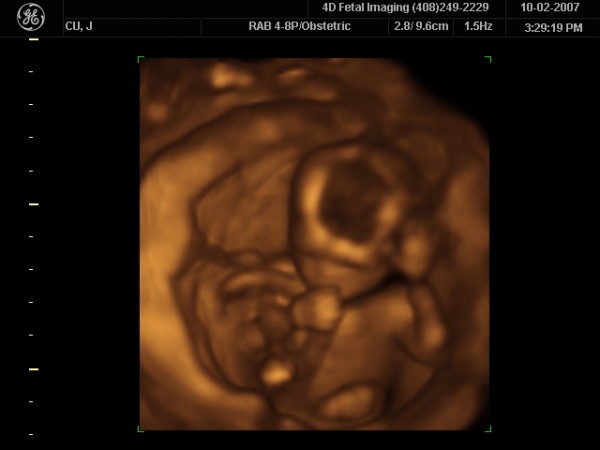
Effigy v. A 3D ultrasound image of a fetus. Every bit well as for the detection of any abnormalities, such scans take also been shown to be useful for strengthening the emotional bonding between parents and their unborn child. (credit: Jennie Cu, Wikimedia Commons)
Whenever a wave is used as a probe, information technology is very hard to observe details smaller than its wavelength λ. Indeed, current technology cannot do quite this well. Abdominal scans may utilize a 7-MHz frequency, and the speed of sound in tissue is about 1540 m/s—and then the wavelength limit to detail would exist [latex]\lambda=\frac{v_{\text{w}}}{f}=\frac{1540\text{ m/s}}{7\times10^6\text{ Hz}}=0.22\text{ mm}\\[/latex]. In exercise, 1-mm detail is attainable, which is sufficient for many purposes. Higher-frequency ultrasound would let greater detail, merely information technology does non penetrate also as lower frequencies do. The accustomed rule of thumb is that you tin can effectively scan to a depth of virtually 500λ into tissue. For vii MHz, this penetration limit is 500 × 0.22 mm, which is 0.11 grand. College frequencies may be employed in smaller organs, such as the eye, but are not practical for looking deep into the trunk.
In add-on to shape information, ultrasonic scans can produce density information superior to that found in 10-rays, considering the intensity of a reflected sound is related to changes in density. Audio is most strongly reflected at places where density changes are greatest.
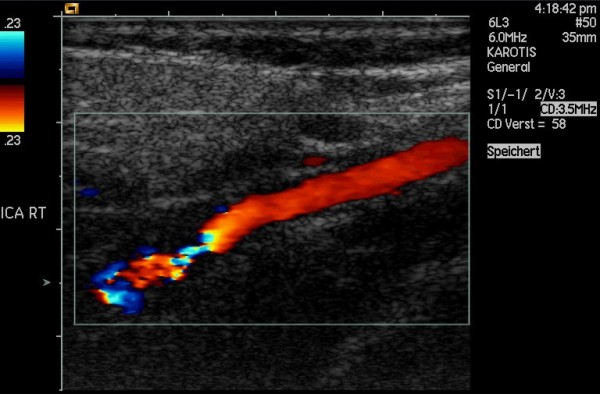
Figure six. This Doppler-shifted ultrasonic prototype of a partially occluded avenue uses color to indicate velocity. The highest velocities are in red, while the lowest are blueish. The blood must motility faster through the constriction to carry the same flow. (credit: Arning C, Grzyska U, Wikimedia Commons)
Another major employ of ultrasound in medical diagnostics is to notice motility and decide velocity through the Doppler shift of an echo, known as Doppler-shifted ultrasound. This technique is used to monitor fetal heartbeat, measure out claret velocity, and detect occlusions in blood vessels, for instance. (Meet Figure 6.) The magnitude of the Doppler shift in an echo is directly proportional to the velocity of whatever reflects the audio. Because an repeat is involved, there is actually a double shift. The first occurs because the reflector (say a fetal heart) is a moving observer and receives a Doppler-shifted frequency. The reflector then acts as a moving source, producing a second Doppler shift.
A clever technique is used to measure out the Doppler shift in an echo. The frequency of the echoed audio is superimposed on the broadcast frequency, producing beats. The beat frequency is F B = |f ane − f two|, and and so information technology is straight proportional to the Doppler shift (f ane − f two) and hence, the reflector'south velocity. The advantage in this technique is that the Doppler shift is small (because the reflector'south velocity is minor), then that great accuracy would exist needed to measure the shift direct. Just measuring the shell frequency is easy, and information technology is not affected if the broadcast frequency varies somewhat. Furthermore, the beat frequency is in the aural range and tin can exist amplified for audio feedback to the medical observer.
Uses for Doppler-Shifted Radar
Doppler-shifted radar echoes are used to measure air current velocities in storms besides equally aircraft and automobile speeds. The principle is the same as for Doppler-shifted ultrasound. There is bear witness that bats and dolphins may too sense the velocity of an object (such as prey) reflecting their ultrasound signals by observing its Doppler shift.
Instance 2. Calculate Velocity of Blood: Doppler-Shifted Ultrasound
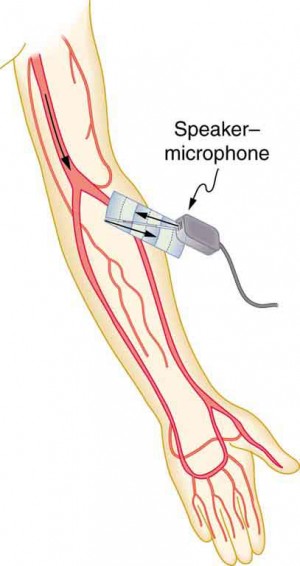
Effigy 7. Ultrasound is partly reflected by blood cells and plasma back toward the speaker-microphone. Considering the cells are moving, ii Doppler shifts are produced—one for claret every bit a moving observer, and the other for the reflected sound coming from a moving source. The magnitude of the shift is directly proportional to claret velocity.
Ultrasound that has a frequency of 2.50 MHz is sent toward blood in an avenue that is moving toward the source at 20.0 cm/s, as illustrated in Figure 7. Employ the speed of audio in human tissue as 1540 m/s. (Presume that the frequency of 2.50 MHz is accurate to seven significant figures.)
- What frequency does the claret receive?
- What frequency returns to the source?
- What trounce frequency is produced if the source and returning frequencies are mixed?
Strategy
The first two questions can be answered using
[latex]f_{\text{obs}}=f_{\text{s}}\left(\frac{v_{\text{w}}}{v_{\text{w}}\pm{v}_{\text{south}}}\correct)\\[/latex] and [latex]f_{\text{obs}}=f_{\text{s}}\left(\frac{v_{\text{due west}}\pm{five}_{\text{obs}}}{v_{\text{westward}}}\right)\\[/latex]
for the Doppler shift. The concluding question asks for beat out frequency, which is the difference between the original and returning frequencies.
Solution for Function 1
Place knowns:
- The claret is a moving observer, and and so the frequency it receives is given by
[latex]f_{\text{obs}}=f_{\text{s}}\left(\frac{v_{\text{w}}\pm{v}_{\text{obs}}}{v_{\text{w}}}\correct)\\[/latex].
- v b is the claret velocity (v obs here) and the plus sign is chosen because the motion is toward the source.
Enter the given values into the equation.
[latex]f_{\text{obs}}=\left(two,500,000\text{ Hz}\right)\left(\frac{1540\text{ g/s}+0.2\text{ m/s}}{1540\text{ m/s}}\right)\\[/latex]
Calculate to notice the frequency: 20,500,325 Hz.
Solution for Part 2
Identify knowns:
- The blood acts as a moving source.
- The microphone acts as a stationary observer.
- The frequency leaving the claret is 2,500,325 Hz, but it is shifted upwardly as given by [latex]f_{\text{obs}}=f_{\text{south}}\left(\frac{v_{\text{w}}}{v_{\text{w}}-v_{\text{b}}}\right)\\[/latex].f obs is the frequency received past the speaker-microphone.
- The source velocity is five b.
- The minus sign is used because the movement is toward the observer.
The minus sign is used because the motion is toward the observer.
Enter the given values into the equation:
[latex]\displaystyle{f}_{\text{obs}}=\left(2,500,325\text{ Hz}\correct)\left(\frac{1540\text{ m/s}}{1540\text{ m/south}-0.200\text{ m/s}}\right)\\[/latex]
Calculate to find the frequency returning to the source: two,500,649 Hz.
Solution for Part 3
Place knowns. The trounce frequency is but the absolute value of the divergence between f s and f obs, as stated in:
f B = |f obs −f s|.
Substitute known values:
|2,500,649 Hz − 2,500,000 Hz|
Summate to detect the beat frequency: 649 Hz.
Give-and-take
The Doppler shifts are quite small compared with the original frequency of ii.50 MHz. It is far easier to measure the beat frequency than information technology is to measure out the repeat frequency with an accuracy neat enough to see shifts of a few hundred hertz out of a couple of megahertz. Furthermore, variations in the source frequency do non greatly affect the trounce frequency, because both f due south and f obswould increase or decrease. Those changes subtract out in f B = |f obs −f due south|.
Industrial and Other Applications of Ultrasound
Industrial, retail, and inquiry applications of ultrasound are mutual. A few are discussed here. Ultrasonic cleaners have many uses. Jewelry, machined parts, and other objects that accept odd shapes and crevices are immersed in a cleaning fluid that is agitated with ultrasound typically about twoscore kHz in frequency. The intensity is peachy enough to cause cavitation, which is responsible for most of the cleansing action. Because cavitation-produced shock pressures are big and well transmitted in a fluid, they reach into small crevices where even a low-surface-tension cleaning fluid might not penetrate.
Sonar is a familiar application of ultrasound. Sonar typically employs ultrasonic frequencies in the range from thirty.0 to 100 kHz. Bats, dolphins, submarines, and even some birds use ultrasonic sonar. Echoes are analyzed to give distance and size information both for guidance and finding casualty. In most sonar applications, the audio reflects quite well because the objects of involvement have significantly different density than the medium in which they travel. When the Doppler shift is observed, velocity data can also be obtained. Submarine sonar can be used to obtain such information, and there is evidence that some bats also sense velocity from their echoes.
Similarly, there are a range of relatively inexpensive devices that measure distance by timing ultrasonic echoes. Many cameras, for example, use such information to focus automatically. Some doors open when their ultrasonic ranging devices notice a nearby object, and certain home security lights turn on when their ultrasonic rangers observe motion. Ultrasonic "measuring tapes" also exist to measure such things every bit room dimensions. Sinks in public restrooms are sometimes automated with ultrasound devices to turn faucets on and off when people wash their hands. These devices reduce the spread of germs and can conserve water.
Ultrasound is used for nondestructive testing in industry and by the armed services. Considering ultrasound reflects well from any large change in density, it can reveal cracks and voids in solids, such as aircraft wings, that are besides small to be seen with x-rays. For similar reasons, ultrasound is also good for measuring the thickness of coatings, particularly where there are several layers involved.
Basic enquiry in solid state physics employs ultrasound. Its attenuation is related to a number of physical characteristics, making information technology a useful probe. Among these characteristics are structural changes such equally those found in liquid crystals, the transition of a material to a superconducting stage, besides as density and other properties.
These examples of the uses of ultrasound are meant to whet the appetites of the curious, besides equally to illustrate the underlying physics of ultrasound. There are many more applications, as you lot tin easily discover for yourself.
Cheque Your Understanding
Why is it possible to use ultrasound both to discover a fetus in the womb and likewise to destroy cancerous tumors in the trunk?
Solution
Ultrasound tin be used medically at different intensities. Lower intensities exercise not cause harm and are used for medical imaging. Higher intensities tin pulverize and destroy targeted substances in the body, such as tumors.
Section Summary
- The acoustic impedance is divers asZ= ρv, ρ is the density of a medium through which the audio travels and v is the speed of audio through that medium.
- The intensity reflection coefficient a, a measure out of the ratio of the intensity of the wave reflected off a boundary between two media relative to the intensity of the incident moving ridge, is given past
[latex]a=\frac{{\left({Z}_{2}-{Z}_{ane}\right)}^{ii}}{{\left({Z}_{ane}+{Z}_{ii}\right)}^{2}}\\[/latex].
- The intensity reflection coefficient is a unitless quantity.
Conceptual Questions
- If aural sound follows a rule of pollex similar to that for ultrasound, in terms of its absorption, would y'all expect the high or low frequencies from your neighbor's stereo to penetrate into your house? How does this expectation compare with your experience?
- Elephants and whales are known to use infrasound to communicate over very big distances. What are the advantages of infrasound for long altitude communication?
- It is more difficult to obtain a high-resolution ultrasound image in the abdominal region of someone who is overweight than for someone who has a slight build. Explicate why this statement is authentic.
- Suppose you read that 210-dB ultrasound is beingness used to pulverize cancerous tumors. You calculate the intensity in watts per centimeter squared and discover it is unreasonably high (x5 West/cm2). What is a possible explanation?
Bug & Exercises
Unless otherwise indicated, for problems in this department, assume that the speed of audio through human being tissues is 1540 m/due south.
- What is the sound intensity level in decibels of ultrasound of intensity ten5 West/mtwo, used to pulverize tissue during surgery?
- Is 155-dB ultrasound in the range of intensities used for deep heating? Calculate the intensity of this ultrasound and compare this intensity with values quoted in the text.
- Find the sound intensity level in decibels of ii.00 × 10−2 Westward/thousandii ultrasound used in medical diagnostics.
- The fourth dimension delay between transmission and the inflow of the reflected wave of a indicate using ultrasound traveling through a piece of fat tissue was 0.xiii ms. At what depth did this reflection occur?
- In the clinical use of ultrasound, transducers are always coupled to the skin past a sparse layer of gel or oil, replacing the air that would otherwise exist between the transducer and the pare. (a) Using the values of audio-visual impedance given in Table i summate the intensity reflection coefficient between transducer material and air. (b) Calculate the intensity reflection coefficient between transducer material and gel (assuming for this problem that its audio-visual impedance is identical to that of water). (c) Based on the results of your calculations, explicate why the gel is used.
- (a) Calculate the minimum frequency of ultrasound that will allow you to see details equally minor as 0.250 mm in human tissue. (b) What is the effective depth to which this audio is constructive every bit a diagnostic probe?
- (a) Find the size of the smallest particular observable in human tissue with 20.0-MHz ultrasound. (b) Is its effective penetration depth great enough to examine the entire eye (nigh 3.00 cm is needed)? (c) What is the wavelength of such ultrasound in 0ºC air?
- (a) Echo times are measured by diagnostic ultrasound scanners to determine distances to reflecting surfaces in a patient. What is the difference in echo times for tissues that are 3.50 and 3.threescore cm beneath the surface? (This difference is the minimum resolving time for the scanner to see details as small as 0.100 cm, or ane.00 mm. Bigotry of smaller fourth dimension differences is needed to see smaller details.) (b) Discuss whether the menstruationT of this ultrasound must exist smaller than the minimum fourth dimension resolution. If so, what is the minimum frequency of the ultrasound and is that out of the normal range for diagnostic ultrasound?
- (a) How far apart are two layers of tissue that produce echoes having round-trip times (used to mensurate distances) that differ by 0.750 μs? (b) What minimum frequency must the ultrasound accept to encounter detail this small-scale?
- (a) A bat uses ultrasound to find its style amidst trees. If this bat can detect echoes 1.00 ms autonomously, what minimum distance between objects can it detect? (b) Could this distance explain the difficulty that bats have finding an open door when they accidentally get into a business firm?
- A dolphin is able to tell in the night that the ultrasound echoes received from two sharks come from two dissimilar objects but if the sharks are separated by three.50 m, one being that much farther away than the other. (a) If the ultrasound has a frequency of 100 kHz, bear witness this ability is non limited by its wavelength. (b) If this ability is due to the dolphin'south ability to detect the arrival times of echoes, what is the minimum time difference the dolphin can perceive?
- A diagnostic ultrasound echo is reflected from moving claret and returns with a frequency 500 Hz higher than its original 2.00 MHz. What is the velocity of the blood? (Assume that the frequency of 2.00 MHz is accurate to vii significant figures and 500 Hz is accurate to three significant figures.)
- Ultrasound reflected from an oncoming bloodstream that is moving at xxx.0 cm/south is mixed with the original frequency of 2.l MHz to produce beats. What is the beat frequency? (Assume that the frequency of ii.50 MHz is accurate to seven significant figures.)
Glossary
acoustic impedance: holding of medium that makes the propagation of audio waves more hard
intensity reflection coefficient: a measure of the ratio of the intensity of the wave reflected off a boundary betwixt ii media relative to the intensity of the incident wave
Doppler-shifted ultrasound: a medical technique to detect motility and determine velocity through the Doppler shift of an echo
Selected Solutions to Bug & Exercises
1. 170 dB
3. 103 dB
v. (a) one.00; (b) 0.823; (c) Gel is used to facilitate the manual of the ultrasound between the transducer and the patient'south body.
7. (a) 77.0 μm; (b) Effective penetration depth = 3.85 cm, which is enough to examine the eye; (c) 16.6 μm
9. (a) five.78 × x−4 g; (b) ii.67 × 106 Hz
11. (a) [latex]{v}_{\text{w}}=1540\text{ m/southward}=f\lambda\Rightarrow\lambda=\frac{1540\text{ thousand/s}}{100\times {x}^{three}\text{Hz}}=0.0154\text{ thou}<3.50\text{ thou}\\[/latex]. Because the wavelength is much shorter than the distance in question, the wavelength is not the limiting cistron; (b) 4.55 ms
xiii. 974 Hz (Note: extra digits were retained in club to prove the departure.)
Is It Difficult to Read an Ultrasound
Source: https://courses.lumenlearning.com/physics/chapter/17-7-ultrasound/
0 Response to "Is It Difficult to Read an Ultrasound"
Post a Comment