What Problem Would Most Likely Occur if a Haploid Cell Attempted to Perform Meiosis?
Affiliate 7: Introduction to the Cellular Basis of Inheritance
7.ane Sexual Reproduction
Learning Objectives
Past the end of this department, you will be able to:
- Explain that variation among offspring is a potential evolutionary advantage resulting from sexual reproduction
- Draw the 3 dissimilar life-cycle strategies among sexual multicellular organisms and their commonalities
- Understand why you lot could never create a gamete that would be identical to either of the gametes that made yo
Sexual reproduction was an early evolutionary innovation later on the appearance of eukaryotic cells. The fact that virtually eukaryotes reproduce sexually is evidence of its evolutionary success. In many animals, it is the only mode of reproduction. And yet, scientists recognize some real disadvantages to sexual reproduction. On the surface, offspring that are genetically identical to the parent may appear to be more advantageous. If the parent organism is successfully occupying a habitat, offspring with the same traits would be similarly successful. There is too the obvious benefit to an organism that tin can produce offspring past asexual budding, fragmentation, or asexual eggs. These methods of reproduction do non crave some other organism of the opposite sex. There is no need to expend energy finding or attracting a mate. That energy tin exist spent on producing more offspring. Indeed, some organisms that lead a solitary lifestyle have retained the ability to reproduce asexually. In addition, asexual populations only have female individuals, so every individual is capable of reproduction. In contrast, the males in sexual populations (half the population) are not producing offspring themselves. Because of this, an asexual population tin grow twice as fast equally a sexual population in theory. This ways that in competition, the asexual population would accept the advantage. All of these advantages to asexual reproduction, which are also disadvantages to sexual reproduction, should mean that the number of species with asexual reproduction should exist more mutual.
Still, multicellular organisms that exclusively depend on asexual reproduction are exceedingly rare. Why is sexual reproduction then common? This is i of the important questions in biology and has been the focus of much research from the latter one-half of the twentieth century until now. A likely explanation is that the variation that sexual reproduction creates amid offspring is very important to the survival and reproduction of those offspring. The only source of variation in asexual organisms is mutation. This is the ultimate source of variation in sexual organisms. In add-on, those different mutations are continually reshuffled from one generation to the next when different parents combine their unique genomes, and the genes are mixed into unlike combinations by the process of meiosis. Meiosis is the division of the contents of the nucleus that divides the chromosomes among gametes. Variation is introduced during meiosis, as well as when the gametes combine in fertilization.
The Blood-red Queen Hypothesis
There is no question that sexual reproduction provides evolutionary advantages to organisms that employ this machinery to produce offspring. The problematic question is why, even in the confront of adequately stable conditions, sexual reproduction persists when it is more than hard and produces fewer offspring for private organisms? Variation is the outcome of sexual reproduction, but why are ongoing variations necessary? Enter the Ruddy Queen hypothesis, first proposed by Leigh Van Valen in 1973. 1 The concept was named in reference to the Red Queen's race in Lewis Carroll'due south volume, Through the Looking-Glass, in which the Red Queen says one must run at total speed but to stay where one is.
All species coevolve with other organisms. For instance, predators coevolve with their casualty, and parasites coevolve with their hosts. A remarkable example of coevolution between predators and their casualty is the unique coadaptation of night flying bats and their moth prey. Bats observe their prey by emitting high-pitched clicks, but moths have evolved simple ears to hear these clicks so they tin avert the bats. The moths have too adapted behaviors, such every bit flying away from the bat when they commencement hear information technology, or dropping all of a sudden to the ground when the bat is upon them. Bats have evolved "placidity" clicks in an endeavor to evade the moth's hearing. Some moths have evolved the ability to respond to the bats' clicks with their own clicks every bit a strategy to confuse the bats echolocation abilities.
Each tiny reward gained past favorable variation gives a species an edge over close competitors, predators, parasites, or even casualty. The just method that will allow a coevolving species to keep its own share of the resource is likewise to continually improve its power to survive and produce offspring. As one species gains an advantage, other species must also develop an advantage or they will be outcompeted. No unmarried species progresses too far alee considering genetic variation among progeny of sexual reproduction provides all species with a mechanism to produce adapted individuals. Species whose individuals cannot keep upwardly become extinct. The Carmine Queen'due south catchphrase was, "It takes all the running yous tin do to stay in the same place." This is an apt description of coevolution between competing species.
Life Cycles of Sexually Reproducing Organisms
Fertilization and meiosis alternate in sexual life cycles. What happens between these 2 events depends on the organism. The process of meiosis reduces the resulting gamete's chromosome number by half. Fertilization, the joining of two haploid gametes, restores the diploid status. There are three main categories of life cycles in multicellular organisms: diploid-dominant, in which the multicellular diploid stage is the about obvious life phase (and there is no multicellular haploid stage), equally with most animals including humans; haploid-dominant, in which the multicellular haploid stage is the nearly obvious life stage (and at that place is no multicellular diploid stage), every bit with all fungi and some algae; and alternation of generations, in which the two stages, haploid and diploid, are apparent to one degree or another depending on the group, as with plants and some algae.
Most all animals use a diploid-dominant life-bicycle strategy in which the simply haploid cells produced past the organism are the gametes. The gametes are produced from diploid germ cells, a special prison cell line that only produces gametes. One time the haploid gametes are formed, they lose the ability to divide again. There is no multicellular haploid life stage. Fertilization occurs with the fusion of 2 gametes, usually from dissimilar individuals, restoring the diploid state (Effigy vii.2 a).
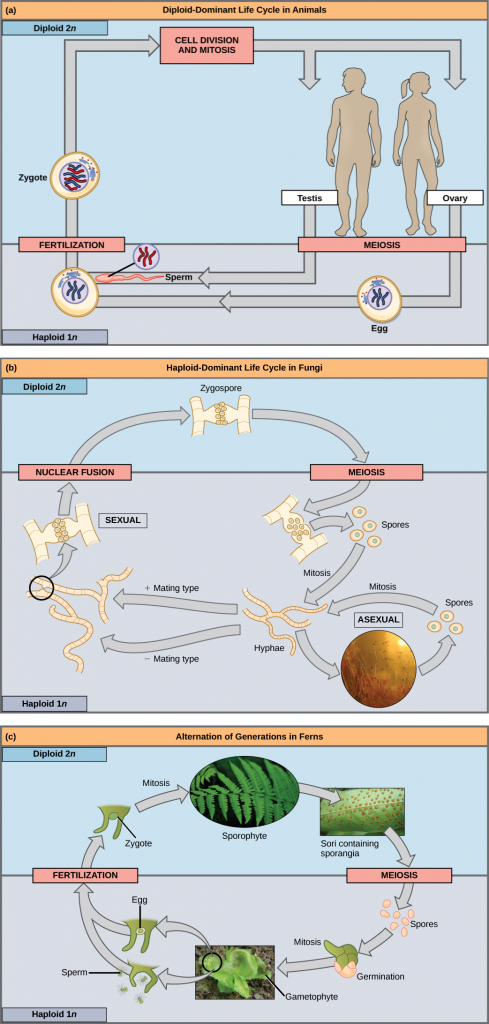
If a mutation occurs so that a mucus is no longer able to produce a minus mating type, will it yet exist able to reproduce?
Nigh fungi and algae employ a life-wheel strategy in which the multicellular "body" of the organism is haploid. During sexual reproduction, specialized haploid cells from ii individuals bring together to form a diploid zygote. The zygote immediately undergoes meiosis to grade four haploid cells called spores (Effigy vii.2 b).
The third life-cycle type, employed past some algae and all plants, is called alternation of generations. These species have both haploid and diploid multicellular organisms equally part of their life bike. The haploid multicellular plants are called gametophytes because they produce gametes. Meiosis is not involved in the production of gametes in this example, as the organism that produces gametes is already haploid. Fertilization between the gametes forms a diploid zygote. The zygote will undergo many rounds of mitosis and give rise to a diploid multicellular found called a sporophyte. Specialized cells of the sporophyte will undergo meiosis and produce haploid spores. The spores will develop into the gametophytes (Figure seven. 2 c).
Section Summary
Nearly all eukaryotes undergo sexual reproduction. The variation introduced into the reproductive cells by meiosis appears to be ane of the advantages of sexual reproduction that has made it so successful. Meiosis and fertilization alternate in sexual life cycles. The process of meiosis produces genetically unique reproductive cells called gametes, which accept half the number of chromosomes as the parent cell. Fertilization, the fusion of haploid gametes from ii individuals, restores the diploid condition. Thus, sexually reproducing organisms alternate betwixt haploid and diploid stages. However, the ways in which reproductive cells are produced and the timing between meiosis and fertilization vary profoundly. There are 3 principal categories of life cycles: diploid-ascendant, demonstrated by almost animals; haploid-dominant, demonstrated by all fungi and some algae; and alternation of generations, demonstrated past plants and some algae.
Glossary
alternation of generations: a life-cycle type in which the diploid and haploid stages alternate
diploid-dominant: a life-bicycle type in which the multicellular diploid stage is prevalent
haploid-dominant: a life-cycle blazon in which the multicellular haploid stage is prevalent
gametophyte: a multicellular haploid life-bicycle stage that produces gametes
germ cell: a specialized cell that produces gametes, such as eggs or sperm
life cycle: the sequence of events in the evolution of an organism and the product of cells that produce offspring
meiosis: a nuclear division process that results in four haploid cells
sporophyte: a multicellular diploid life-cycle stage that produces spores
Footnotes
1 Leigh Van Valen, "A new evolutionary police force," Evolutionary Theory 1 (1973): 1–30.
Source: https://opentextbc.ca/biology/chapter/7-1-sexual-reproduction/
0 Response to "What Problem Would Most Likely Occur if a Haploid Cell Attempted to Perform Meiosis?"
Post a Comment